Cursive Practice Sheets
Free printable cursive worksheets to trace and practice, or make your own in seconds.
-
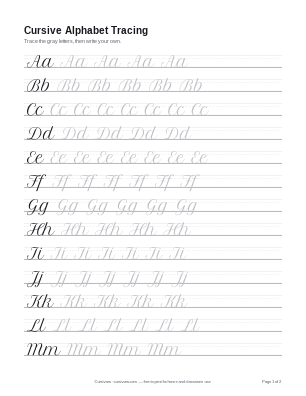
Alphabet tracing (A–Z)
2 pages · US Letter
PDF -
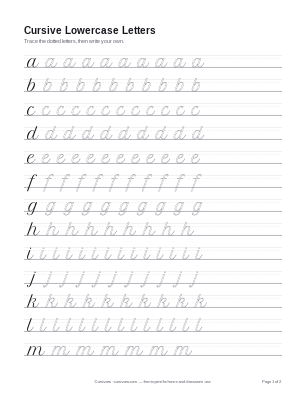
Lowercase letters
2 pages · US Letter
PDF -
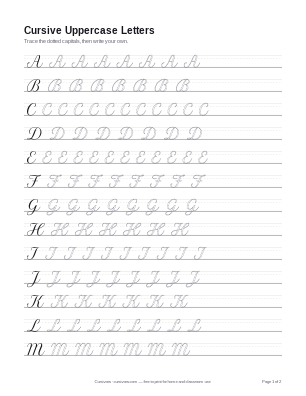
Uppercase letters
2 pages · US Letter
PDF -
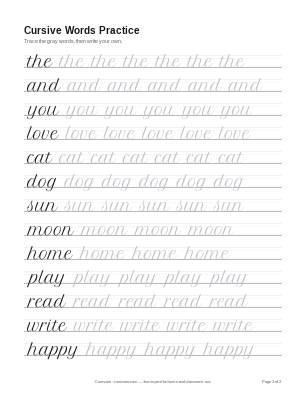
Words
2 pages · US Letter
PDF -
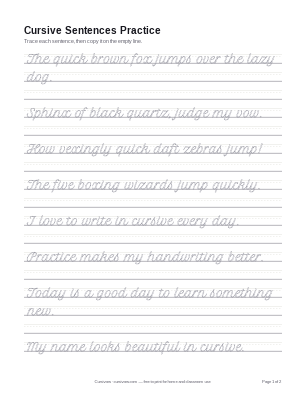
Sentences
2 pages · US Letter
PDF -
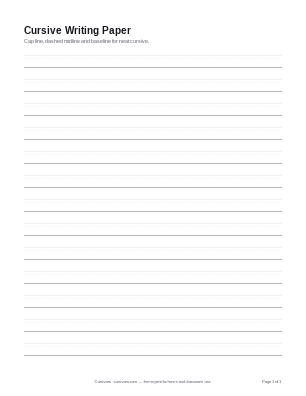
Writing paper
1 page · US Letter
PDF
Make your own worksheet
Type letters, words, a sentence or a name, pick a style and download a free tracing worksheet.
The preview appears here.
These cursive writing practice sheets cover everything from the first letters to full sentences. Each one prints on standard US Letter paper with three guide lines: a top line for capitals, a dashed middle line for small letters, and a baseline to write on.
Which worksheet should you start with?
Pick the sheet that matches where you are right now:
- Brand new to cursive? Start with the lowercase letters sheet. Small letters do most of the work, because they are the ones that join together.
- Know the small letters? Move on to uppercase letters. Capitals are fancier, but you only need one per word.
- Can write every letter? Use the words sheet to practice joining letters, then the sentences sheet to build speed and rhythm.
- Want a quick warm-up? The alphabet tracing sheet pairs each capital with its small letter, A to Z.
- Ready to write freely? Print the blank cursive writing paper and copy anything you like: a poem, a shopping list, a letter to a friend.
If you just need a reference to look at while you write, keep the cursive alphabet chart next to your worksheet.
How to use the worksheet maker
The worksheet maker turns any text into a printable tracing sheet. It’s handy for names, spelling words or a favorite quote.
- Type your text. Letters, words, a sentence or a name, up to 150 characters.
- Choose a style. Tracing (dotted) is best for beginners, Faded gray is a step up, and Blank lines is for copying from the model on your own.
- Pick the details. Choose Classic or Modern letters, a letter size, how many rows to practice each line, US Letter or A4 paper, and whether to add a name and date line.
- Download the PDF. The preview shows page one, and the PDF includes every page.
Teachers can make a sheet for each child’s name in a minute, and parents can turn this week’s spelling list into handwriting practice.
How to practice cursive: a 2-week plan
Ten to fifteen minutes a day works far better than one long session on the weekend. Here’s a simple plan:
- Days 1–3: easy lowercase letters. Start with letters that begin with the same upward stroke: i, t, u, w, e and l. Trace each one, then write it three times on your own.
- Days 4–6: the rest of the lowercase. Add the round letters (a, c, d, g, o, q) and the hump letters (m, n, v, x, y, z). Finish with the tricky ones: b, f, k, r and s.
- Days 7–9: capitals. Do four or five uppercase letters a day. Start with the letters in your own name, because you’ll use them most.
- Days 10–12: joining words. Use the words sheet. Focus on smooth joins and keeping small letters the same height, right up to the dashed line.
- Days 13–14: sentences. Trace a sentence, then copy it on the blank line below. “The quick brown fox jumps over the lazy dog” uses every letter, so it’s a great test.
After two weeks, keep going with a few lines of real writing every day. A journal, a note or a birthday card all count.
Tips for parents and teachers
- Check the grip and posture first. A relaxed pencil grip, feet on the floor and the paper tilted slightly make a bigger difference than extra practice.
- Tilt the paper. Right-handed writers usually tilt the top of the page a little to the left, and left-handed writers tilt it a little to the right. This makes the cursive slant feel natural.
- Praise neat letters, not speed. Speed comes on its own once the shapes are right.
- Use the dashed middle line. Most messy cursive comes from small letters that grow taller and taller. The middle line keeps them even.
- Make it personal. Kids practice longer when the worksheet has their own name, a pet’s name or a favorite word on it.
- Stop before they get tired. A short session that ends on a good letter is better than one that ends in frustration.
Tips for printing
Choose Actual size or 100% in your print dialog so the guide lines print at the right height. Black-and-white printing is fine. The dotted letters are a darker gray so they still show clearly on cheaper printers. For repeat practice, slip a sheet into a clear plastic sleeve and trace with a dry-erase marker.
Frequently asked questions
Are these cursive worksheets really free?
Yes. Every PDF on this page and every worksheet you make is free for home and classroom use. There is no sign-up and no watermark over your letters, just a small cursivora.com line at the bottom, and you can print as many copies as you need.
How do I print the worksheets at the right size?
The ready-made sheets are US Letter. In the print dialog choose Actual size (100%) so the guide lines keep their spacing. If your printer uses A4 paper, choose Fit to page, or make an A4 worksheet with the worksheet maker.
How long does it take to learn cursive?
Most children and adults can write every letter after two to three weeks of short daily practice. Writing smoothly and quickly takes a few months of regular use, like any handwriting.
What age should kids start cursive?
Many US schools introduce cursive in second or third grade, around ages 7 to 8, once children can print letters comfortably. Older kids and adults can start any time.
Can I make a tracing worksheet with my child's name?
Yes. Type the name into the worksheet maker, pick Tracing (dotted) and download the PDF. The first row shows the name in ink, and the next rows are ready to trace.
Which cursive style do the worksheets use?
The printable sheets use a classic, traditional cursive font. The worksheet maker also has a Modern style with fewer loops. Neither is an official school method, so a few letters may look different from your child's school worksheets.
Do the worksheets work for left-handed writers?
Yes. The sheets are the same for everyone. Left-handed writers usually find it easier to tilt the paper slightly to the right and keep the hand below the line they are writing.